Expressvpn Glossary
Database-as-a-Service

What is Database-as-a-Service?
Database-as-a-Service (DBaaS) is a cloud computing service that provides pay-as-you-go, scalable access to database software without requiring users to set up or maintain their own database infrastructure. Users can interact with the service via a web console or APIs, while the provider manages the setup, scaling, and backups.
How does Database-as-a-Service work?
The first step involves provisioning a database instance without the need to manage underlying servers. When creating the instance, you allocate resources such as compute capacity (CPU and memory) and storage. Billing is based on the resources provisioned and how long the instance remains active.
Once provisioning is done, the DBaaS provider handles infrastructure and routine operations, including automated patching and maintenance. Clients remain responsible for configuring access controls, securing their data, and managing application-level security settings. Users can access the database through web consoles, APIs, or query interfaces, and access is controlled via identity and access management (IAM) and networking rules.
DBaaS platforms provide built-in replication and high availability to improve reliability and support disaster recovery. Providers can also scale resources on demand, adding storage or compute capacity as needed.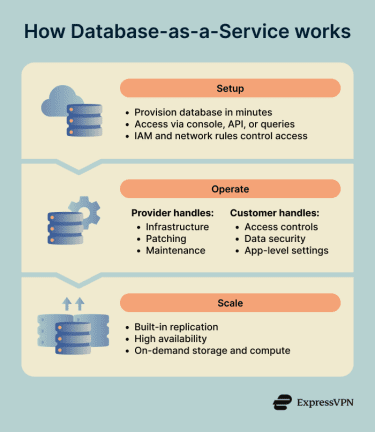
Types of Database-as-a-Service
- Relational DBaaS (SQL engines): Organize data in tables with rows and columns using primary and foreign keys to define relationships.
- NoSQL DBaaS (document, key-value): Store data in flexible formats for unstructured or semi-structured data.
- Managed data warehouse services: Cloud-based warehouses offer fully managed, scalable solutions for analytics workloads and complex queries across large datasets.
- Managed time-series databases: Optimized for time-stamped data like sensor readings, stock prices, or server logs.
- Managed graph databases: Represent and traverse relationships between data points; help applications like social networks determine relationships between data.
Why is Database-as-a-Service important?
DBaaS enables convenient data management by shifting operational burdens to cloud providers, freeing up organizational resources to focus on business growth and innovation.
It also allows significantly faster scaling; providers offer on-demand scalability options, which organizations can use to scale databases without having to manually deploy hardware.
Where is it used?
- Web and mobile app backends: Stores user data, content, and application state with scalability that supports fluctuating traffic patterns.
- Software-as-a-Service (SaaS) products: Provides infrastructure for SaaS applications, enabling developers to focus on their core product.
- Machine learning (ML): Offers storage and access to datasets needed for AI and ML development.
- Internet-of-Things (IoT) telemetry and event ingestion: Handles high-volume, time-series data from IoT sensors.
Risks and privacy concerns
DBaaS security concerns generally stem from how organizations configure and manage access rather than from the platform itself. Common risks include misconfigured access or weak IAM roles, which can expose databases to the public or allow attackers to leverage leaked credentials. Gaps in data encryption or poor key management may also put sensitive information at risk, while improperly secured backups could result in unintended data leakage.
Another issue stems from multi-tenant environments, where improper permissions could lead to sensitive databases being exposed on public endpoints. Finally, compliance requirements must be carefully addressed to avoid legal or operational issues.
Further reading
- Zero-trust cloud security explained
- What is a virtual private cloud (VPC)?
- What is SQL injection? How it works and how to prevent it
- Why software security audits matter
- Encryption protocols explained: What they are and how they work