How to change DNS on PS5 and improve your connection for online play


Changing the Domain Name System (DNS) settings on a PlayStation 5 (PS5) can sometimes help the console reach online services more efficiently, which may improve connection setup or resolve certain network issues. However, it's not a universal speed boost, and results depend on the network setup, the internet service provider (ISP) routing, and the selected DNS service.
This guide explains how to change DNS settings on PS5, what DNS changes can and can’t improve, when it's worth trying, and what can go wrong if the settings are entered incorrectly.
Quick overview: What DNS does on PS5
DNS is the service that translates human-readable names, such as PlayStation Network (PSN) or a game service domain, into the numeric IP addresses devices use to connect online. By default, most home networks use the ISP-provided DNS resolver (via the router), but a PS5 can be configured to use a public resolver instead.
When the PS5 needs to reach an online service, it sends a DNS query to a resolver. If the resolver already has a recent answer stored, it can reply immediately. If not, it performs a recursive lookup (following referrals until it reaches the authoritative DNS servers that hold the current record), then returns the result and typically caches it for next time.
Before you start: What you need to know
Changing DNS is optional and usually worth trying when there are signs of DNS-related connection issues, such as repeated resolution errors or timeouts, or when there is a specific reason to use a particular public resolver.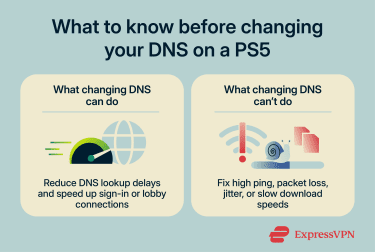
When changing DNS can help
Changing DNS can help when the issue involves name resolution during connection setup. DNS is used when the PS5 signs in and reaches online services (for example, opening the store, contacting matchmaking, or joining a lobby). If the current resolver is slow, overloaded, or timing out, switching to a reputable public resolver can reduce lookup delays and make these steps feel quicker.
The improvement is usually small, but it can be noticeable when the current resolver is inconsistent. Many large public DNS services use globally distributed anycast networks that route queries to a nearby or available node, which can improve responsiveness and resilience during congestion or localized failures.
Switching DNS is also a practical troubleshooting step when errors point to resolution problems (for example, “can’t resolve server”–type messages). In those cases, testing a different resolver helps determine whether the issue is tied to the current DNS resolver rather than the console or the wider connection.
Security can be another reason to switch. Some public resolvers block domains associated with malware or phishing by refusing to return an address for known harmful destinations. This can reduce exposure at the DNS step, but it’s an extra layer rather than a replacement for updates and account security.
Also read: What is DNS spoofing? Learn how it affects security.
When changing DNS will not fix the lag
DNS affects name resolution, not gameplay traffic. Changing DNS typically doesn’t reduce in-game ping once a match is established, and it will not fix packet loss, jitter, or congestion. Those issues are usually caused by wireless interference, ISP congestion, game server load, or routing conditions beyond the local network. The impact of DNS changes depends on whether and when a game or service performs DNS lookups during connection setup.
Also read: Internet speed for gaming: How fast do you really need?
Choosing between automatic and manual DNS
By default, the PS5 uses the standard network settings provided during setup. In many home networks, DNS server addresses are assigned automatically by the router through the Dynamic Host Configuration Protocol (DHCP). This is usually the simplest option because it avoids mistakes that can happen with manual entry.
Manual DNS is mainly useful when a specific resolver is required for testing or troubleshooting, or when there is a clear reason to use a particular public resolver. In that case, the PS5 uses the DNS server addresses entered in the network settings, so accuracy matters. One wrong digit can prevent name resolution and break connectivity.
Also read: What is DNS time to live (TTL)? Best practices for privacy and performance.
How to change DNS settings on PS5
Changing DNS on a PS5 is a straightforward setting change, and it can be reverted at any time. The PS5 network menu also includes a built-in Test Internet Connection tool to check whether the console can connect after the new settings are saved.
Set a custom DNS on PS5: Step-by-step guide
To change DNS on PS5:
- Open Settings.

- Go to Network.

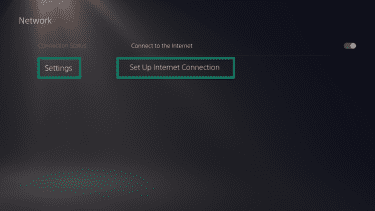
- Open the Settings menu and choose Set Up Internet Connection.
- Select the current connection and open Advanced Settings. For a wired connection, choose Set Up Wired LAN first; for Wi-Fi, choose the saved wireless network first.
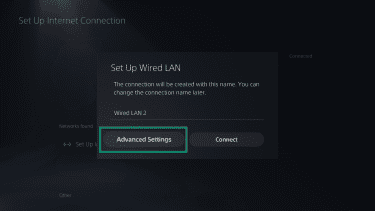
- Set DNS Settings to Manual.
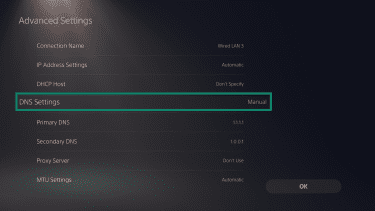
- Enter Primary DNS (the resolver the PS5 tries first) and Secondary DNS (the backup used if the primary is unavailable or not working properly). Take a look at the recommended DNS values to try first.

- Press OK to save.
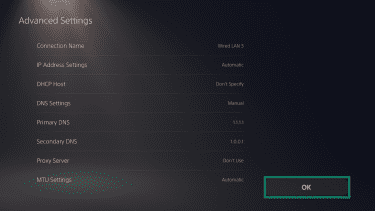
Note: If an error appears after saving, double-check each digit. If manual DNS settings are incorrect, hostname resolution can fail. To revert, repeat the steps and set DNS Settings back to Automatic.
How to save and test your internet connection
- Go to Settings > Network.
- Open Connection Status and select Test Internet Connection.
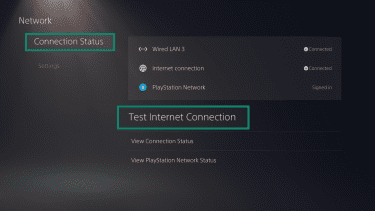
- Confirm your choice and allow the test to complete.
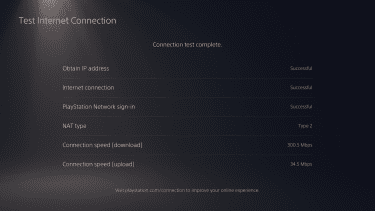
The test checks that the PS5 can connect to the network, access the internet, and reach PSN. A successful result indicates that the console’s basic network connection is working after the DNS change, though it does not confirm DNS performance on its own. Check what to do if the test fails.
Learn more: Check out how to clear cache on PS5 to improve performance.
Best public DNS servers for gaming on PS5
Different public DNS providers emphasize different trade-offs around performance, security features, and data handling. This section lists common options (including the DNS values needed for PS5 manual entry) and what typically differentiates them. Performance can vary by location and network conditions, so there is no single best choice for every player.
Popular performance-focused options
Performance-focused resolvers aim to answer DNS queries quickly and consistently.
- Cloudflare: 1.1.1.1 (primary) and 1.0.0.1 (secondary). Cloudflare is commonly chosen for its large global anycast network and reputation for low-latency resolution.
- Google Public DNS: 8.8.8.8 (primary) and 8.8.4.4 (secondary). Google Public DNS is also widely used and known for its consistent performance. It keeps temporary logs that may include the client IP address and query details for 24–48 hours, though some temporary log information may be retained longer for security and abuse handling. Google also keeps longer-term anonymized and aggregated data.
Privacy- and security-focused options
Privacy-focused services emphasize limited retention and clear policies around how resolver data is handled. Some services also add security by blocking known malicious domains.
- Cloudflare: 1.1.1.1 / 1.0.0.1. The service is often chosen for performance, but it's also commonly considered in privacy comparisons because it retains limited public resolver logs and deletes them within 25 hours, and it deletes truncated IP addresses within 25 hours.
- Quad9: 9.9.9.9 (primary) and 149.112.112.112 (secondary). Quad9 is designed to block domains associated with malware, phishing, and spyware. It focuses on threat protection rather than content filtering and positions its service around the privacy-focused handling of DNS data. Users who do not want threat blocking can use Quad9’s separate no-blocking resolver instead.
When evaluating privacy, it can also matter whether the resolver supports encrypted DNS. Two common standards are DNS over HTTPS (DoH) and DNS over TLS (DoT), which encrypt DNS queries between a device (or router) and the resolver. Encryption reduces visibility of DNS lookups to intermediaries on the network path. On PS5, though, manual DNS entry does not by itself confirm encrypted DNS use, so that benefit may depend on the router or network setup rather than the console alone.
Also read: What is private DNS? The complete guide to privacy and security.
Quick comparison: Google vs. Cloudflare vs. Quad9
| Top benefit | Top drawback | |
| Google DNS | Consistent, widely used resolver | Temporary logging includes more query-related data than some privacy-focused alternatives |
| Cloudflare | Strong performance reputation and short log retention | The default resolver does not provide content filtering or threat blocking |
| Quad9 | Strong anti-malware and anti-phishing protection | Security blocking can occasionally block a legitimate domain by mistake |
How to pick the best DNS for your location
Performance can vary by region and time of day, even for the same provider. A practical approach is to test a few options using the PS5 connection test after each change, then repeat the test during typical play hours to confirm consistency. Keep the pair that produces stable results across repeated tests.
Learn more: Check out the best DNS servers for gaming.
Troubleshooting after changing DNS
If problems appear after switching DNS, the most useful first step is to confirm whether the issue is caused by a typo in the DNS values or by something else on the network. DNS changes are reversible, and some connection problems are unrelated to DNS.
If the connection test fails
A failed test can be caused by incorrect manual entries, an unreachable resolver, or a broader network or PSN issue. Verify the Primary DNS and Secondary DNS values digit-by-digit, with no extra spaces or characters. Confirm the router has an active internet connection and that PSN isn’t experiencing an outage.
To isolate the cause, set DNS settings back to automatic and run the test again. If automatic works and manual doesn’t, the manual DNS values may be incorrect, or the chosen resolver may not be working properly on that network. Testing a different resolver pair is a practical next step.
If online play is still laggy
Lag during gameplay is usually driven by connection quality and routing after the session is established, not by DNS. DNS lookups mainly occur during connection setup, and cached results reduce how often lookups are repeated.
If lag persists, likely causes include unstable Wi-Fi, ISP congestion, game server load, or routing conditions beyond the local network.
If downloads are slow
Slow downloads are commonly caused by server-side congestion or a bottleneck along the network path. DNS changes may affect how quickly a download starts, but they do not increase the underlying transfer rate.
When troubleshooting sustained slow downloads, common checks include router firmware updates and traffic prioritization features such as Quality of Service (QoS), which can help manage local congestion. If speeds are consistently below the subscribed rate across multiple devices, testing with a wired computer can help determine whether the issue is local or ISP-related.
Learn more: Find out how to test your internet speed.
Tips to reduce lag on PS5
Changing DNS usually doesn’t reduce in-game lag once a match is established. If gameplay still feels laggy, the cause is more often Wi-Fi stability, router configuration, ISP congestion, or game server conditions. The tips below focus on those factors.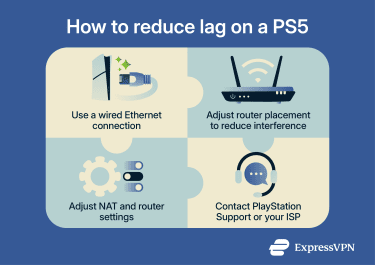
- Use a wired connection: A wired Ethernet connection is typically more stable than Wi-Fi because it avoids wireless interference and reduces the chance of signal-related dropouts.
- Improve Wi‑Fi stability: When using Wi-Fi, router placement and interference matter. A more central, elevated location and distance from other electronics can improve signal quality. Channel congestion can also affect stability; on 2.4GHz networks, channels 1, 6, and 11 are commonly used to reduce overlap.
- Check Network Address Translation (NAT) type and router settings: NAT type can affect connectivity with other players and some online features, particularly in peer-to-peer situations. Some routers also support Universal Plug and Play (UPnP), which can automatically create port mappings for compatible devices on the network, though support varies by router.
- Contact support and your ISP: If problems persist after local network checks, the issue may be upstream (congestion, routing issues, outages). PlayStation Support provides connectivity troubleshooting and a PSN status check, and an ISP can confirm line issues or regional problems outside the home network.
Also read: How to factory reset a PS5 and fix common issues.
FAQ: Common questions about changing DNS on PS5
Does changing DNS reduce lag on PS5?
What is the best DNS for PS5?
Is it safe to use public DNS servers?
Should I use primary and secondary DNS values?
Can changing DNS improve download speed on PS5?
How do I undo my DNS changes on PS5?
Take the first step to protect yourself online. Try ExpressVPN risk-free.
Get ExpressVPN













 Support Center
  FAQ
FAQ  VPN Setup Tutorials